
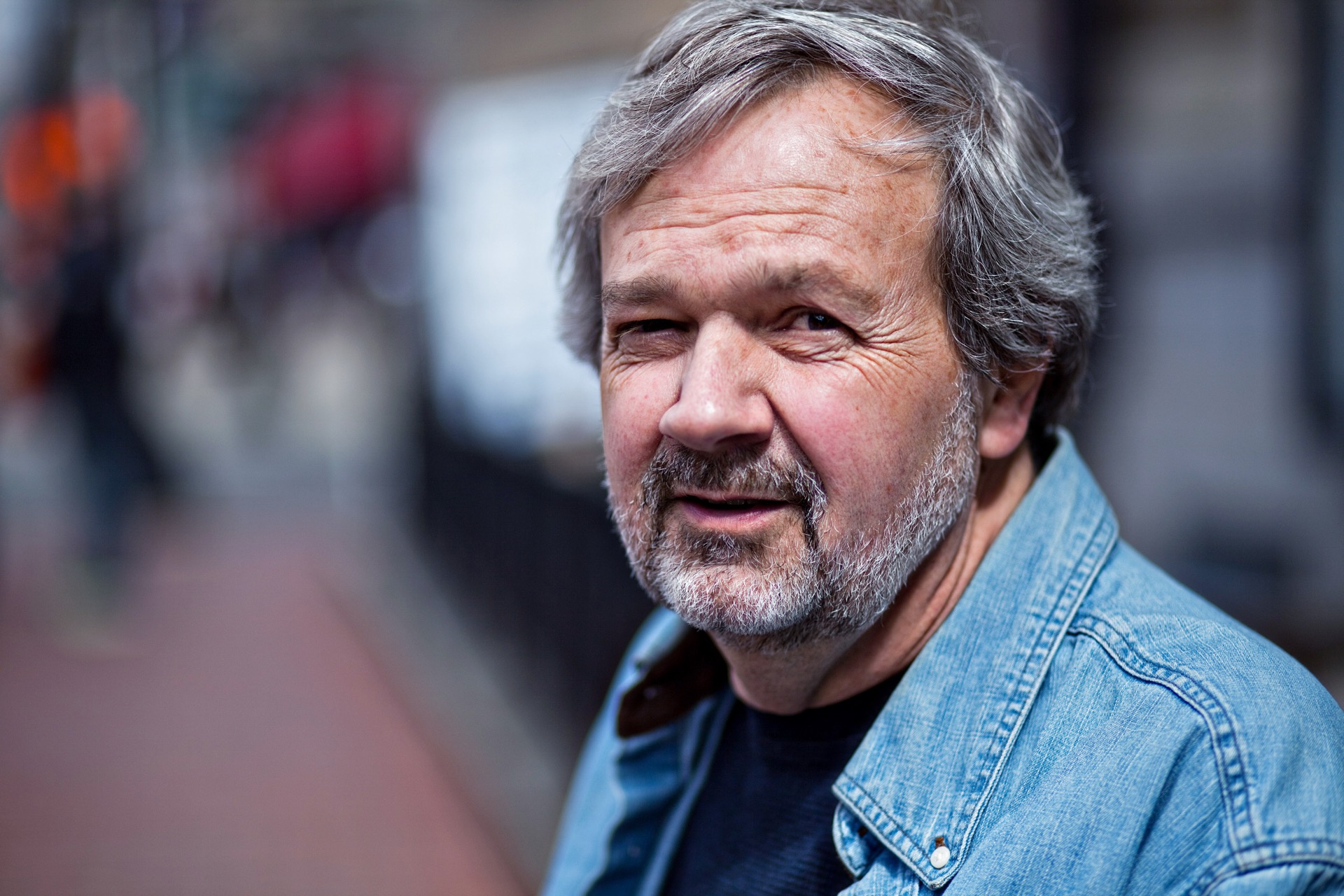
Michael Skinner
is a suicide attempt survivor."I survived a suicide attempt."
Michael Skinner is a musician and mental health advocate who lives in New Hampshire. He was 59 when I interviewed him in Boston on April 5, 2014.
I lived here as a kid, in Cambridge, [until] the age of six, then moved up to Billerica, MA, which is like eighteen miles outside of the city. I’m 59, about to turn the big 6-0. And I’m proud of it, you know—I’ve made it.
So, I’m from this area, and I sometimes joke when I’m coming down here that I’m returning to the scene of the crime. I think it’s important to know that the suicide attempt—the intent—was because of all the childhood abuse that happened. It was both parents and several of their perverted friends, so it was both my mother and father that did these things. All that pain, all that suffering, all that anguish was just in there forever.
Suicide has been around me all my life because—I don’t like calling her my mother, but she is my mother—she had an attempt, and she was my mom, and I didn’t know what was going on. I just knew something was wrong, and then hearing my father talking with his friends, she almost died from a loss of blood. So she comes home—I’m probably maybe eight or nine, maybe ten—and her wrists were all heavily bandaged, but there was no talking about it. It was just… something was awry.
I’ve lost two brothers to suicide, okay? And two friends. My brother, David, he was in the Air Force, and that’s when he started having his attempts. Intent. He went to the VA hospital. They discharged him honorably with the medical, and he just kept having attempts. Eventually, unfortunately, it did happen. Several years later, my brother Danny, the same thing. I’m the oldest of five siblings. Every one of us has had [issues], and it’s got nothing to do with being mentally ill. It’s got to do with the trauma and the abuse that we experienced as kids, because it was pretty horrific. It broke you spiritually. My parents were evil and dark in what they did, ’cause they wanted to crush your spirits. Do I remember parts of it, wanting to die as a kid? Yes and no. I was always a go-getter. I didn’t want to die, but yet I put myself in very risky places. It was a lot of fights, all these dangerous situations I should not have been [in], so was that a death wish? I don’t know.
I made a living as a musician. That’s what I did. I got to tour all over. I toured overseas. United Kingdom. There for two years. I was on the same level as AC/DC back in the mid-70’s. We had a very successful band. That fell apart due to our manager’s drug addiction—having to come back, tax problems, et cetera, et cetera. Still continued performing professionally as a drummer. That’s how I supported my ex-wife and our family. Bought a home, did that for many years, then went into the music business representing a lot of bands. Still played on the weekends, just having fun, you getting paid. I loved representing bands, ’cause I—one, they’re paying me to represent them, and these are people I just love going to hear anyways. I had a management company trying to get people signed to record companies, and that was going really well, but they’d always fall apart just before it happened because of their drugs and the alcohol. Their childhood stuff, right?
So life, if you looked at it back then in ’91, you would have said, “This guy’s got it all. He’s got a successful business; he’s got a beautiful family.”
I had everything I thought I wanted. I was making more money than I could have envisioned. Then all that stuff from the past just started… It was always there, but it wasn’t going away. It just kept getting worse and worse. Eventually I fell apart. I had a nervous breakdown in January of 1993, ‘cause ’92, it just kept getting worse and worse. I can look back in hindsight and understand that I was in a depression. I just didn’t know what a depression was. I didn’t know what post-traumatic stress was. It was everything, because I was making horrible business decisions.
Every day was just, “How do I get through?”
Had the breakdown, the breakthrough. Went into the mental health system. The reason I prefaced with all of what was going on is that I wanted to share that I had a life. I was a functioning human being despite all the pain and suffering.
I get into this mental health system. Now I’m told I’m mentally ill, I will never work again. All I heard was all this stigma and the discrimination. I already felt horrible inside. That self-esteem was now shot even more. Then they had me on so many drugs. They overmedicated me. I’m not against medication helping someone through mental health concerns or whatever, but when you’re overmedicating someone… I had a toxic reaction. I’ve learned now, through my advocacy, that meds are only effective on 40-50% of the people. I was one of the ones it [wasn’t effective for], and they just kept giving me more and more. Keep in mind, despite being in the music business, I never did any drugs in my life. It clouded my head. I was on all these things, and then it was only after the fact [that I learned] they can cause the suicidal ideation. I don’t want to just dismiss that my childhood did not also want me to die, but I feel that the drugs pushed me over. I wasn’t thinking.
So the first attempt, the intent, I was at home, and… I was just ready to go. I felt at peace. I actually felt I’m doing my ex-wife and my daughters, who I loved dearly, a favor. I’m getting out of their life. They’ll be supported. I had insurance, they have the home. I just felt like I was burdening them.
I called my brother Wayne, who’s still alive. I wanted to call him, say I’m sorry that I wasn’t aware what depression could do, and his post-traumatic stress. He went into the mental health system, and he had had a couple attempts… He lived, so thank goodness he survived. I just wanted to say, “I’m sorry I wasn’t more supportive of your pain. I understand now.”
He says, “What?” He goes, “It’s okay,” and then he knew I was saying goodbye.
I’m getting emotional now. He called emergency. He hung up. Next thing I know, the police, the ambulance, they rushed me out.
I was in the hospital for several days… My wife, at the time, was supportive. I give her credit [for] that. She turned against me because she just didn’t want to hang around but, back then, she was supportive. I know this played havoc on her, as well as the kids, ‘cause I had five daughters. Three were teenagers and two were still young. She was in the hospital room, and she was just shaken up.
She says, “Mike, the doctor told me this wasn’t a cry for help. This wasn’t an attempt, this was intent.”
She started advocating to get me off the drugs, ‘cause she was telling them, “This is not my husband; this is not the man I know. He is a self-made man, a go-getter,” da-da-da-da.
I started looking into it. They took me off the Prozac, they put me on others, but there was still this regimen of drugs. She once had a list. It took up a [page of] notebook paper, all the stuff they had me on to help me. It was just screwing up my head. They were poison, they were toxin[s]. I’m still responsible, yes, for the attempt. I think in sharing this, I think people need to know it’s not just wanting to leave this earth. I wasn’t thinking clearly. I was not thinking clearly.
Eventually she left. Within a year. It was a divorce. It was bitter, nasty, kept me from the kids because I’m “mentally ill.” Then throwing out into court—even though there’s never been a history of violence or abuse directed at either her or the kids—just saying to the judge and attorneys, “Well he was sexually abused as a child; I’m worried what he…”
That bombshell just broke me. That literally broke me. I loved my wife at the time. I loved my daughters. They’re the greatest gifts in my life. That was taken from me.
So I’m in the apartment. I was sad. I didn’t know back then I was grieving. I was broken over the loss of my kids. I had another attempt… I knew it would end me. I called my therapist to say goodbye and thank you. Same deal again. Emergency, okay, take me out.
I did start getting better, and I’m learning more and more about the meds, started weaning off. I was still on a fair amount of them. Then within, I’d say, about a year or so… I can look at it now and the meds were screwing up my thinking. I’ll say it was “stinkin’ thinkin’,” ’cause it’s confusion. Plus, with the post-traumatic stress and the depression, I was in a whirlwind. I just wasn’t thinking clearly.
I really did miss my daughters, and I just gave up. This time, I took the phone off the hook, unplugged it. I was in deep pain… To me, it was a miracle, ‘cause I woke up two days later…
I’m on the floor, and I just said, “I gotta stop this, I gotta change my life. Something’s wrong here.”
I did feel it was a miracle. I do believe in something higher. I don’t know what it is. I’m not religious. I’m not gonna sit here and say, “Oh…,” but I do believe a miracle had taken place. I truly do.
When I was a child, sometimes I would sneak out of the house and go out the bulkhead, and what I used to hear… Now, I share. Did I hear voices when I was younger? Yes, but it used to be like this angelic voice: “Michael.” I would get up and I would leave the bed and leave the house and just hide in the woods, ‘cause I knew that they were going to abuse me.
When I [woke up after my last attempt], that’s what [I heard]: “Michael.” That voice again.
That’s when I came out [of it]. To me, I always felt it was like my guardian angel. I’m not trying to be weird or anything, but that was a spiritual something that was keeping me connected and grounded. I realized, “I gotta stop this. I want to live; I don’t want to die.”
I started reading even more on the toxicity of the drugs. Again, I know they help some people, but when it’s overload, it’s toxic. They were not helping me, so I just slowly weaned off all of them. Found all kinds of alternative healing things: mindfulness, everything. Really learning even more about the trauma and the abuse in my life, how it had impacted me. I did everything I could to start being healthier and to take care of myself.
To this day, can I still get suicide thoughts? Yeah. This week has been rough for me. Stuff still comes up, and it’s that sadness, that grieving.
Do I sometimes think, “Oh, it would be better to be gone?” It’ll come in, but I don’t feel the need to act upon it or an urge. I’m grateful to be alive. I’m grateful to be alive, and I’m grateful that you’re doing what you’re doing. I don’t like talking about this, ‘cause it does make me emotional, but we need to break that silence and that stigma.
I’m a big strong guy. I used to be in barroom brawls taking on three or four people, so I’m not a coward. That pain was horrible.
Des: Talk more about “attempt” versus “intent.” I’ve noticed that you pair those words together.
Michael: I wanted out. It was only because the doctor said that to her, to my ex. He felt that this was not a cry for help, that [I] knew what [I] was doing, that [I] wanted to end it. Even that third time, I thought I was doing all the right things to end it… That was my intent. As diabolical as that sounds, that’s what’s twisted, that’s what’s screwed up to this. There was a clear thinking pattern to accomplish this deed. I’m grateful it didn’t work.
Des: I’ve been learning a little more about trauma-informed care recently, because I got shit for posting content that [almost solely] supports the medical model. Now I’m trying to learn a little bit more about what that means. [It’s hard for me to see] the difference if we’re all trying to get people healthy in a good way.
Mary: In order to heal from mental illness, to really heal from it, I think you need to go back and look at what happened to you. If somebody just wants to put a Band-Aid on it, give you a pill, and say, “Okay, you’re mentally ill, shut up,” that’s the difference. You’ll never really be better. [ed. note: Mary is Michael’s partner and was also present for our interview.]
Des: Yeah. Yeah. That’s hard.
Michael: Again, for some folks, medication is going to really help. But I do feel [the distinction is] really important. I do training and consulting on trauma-informed care. It’s part of my advocacy. Again, learning everything I could about trauma, and it does impact us. We’re not mentally ill. The trauma and abuse in our lives affects us mentally, emotionally, physically, spiritually, and socially. That’s every component. It’s not just a diseased brain, or these people looking for these genetic markers. Do I feel maybe I may have been predisposed to having depression? Yeah, I have no problem with that, but if I didn’t have that trauma and abuse in my life, we wouldn’t be talking here. That’s what I’ve learned with so many of the folks who are deemed severely mentally ill. There’s severe trauma and abuse in their lives. It doesn’t have to be child abuse. There can be other things.
As we’re talking, I keep thinking of a man I met years ago, and I wrote a song out of what he shared. I do these music programs in these peer support centers. There could be ten, there could be twenty, sometimes thirty, forty people. I’d share my story, play songs—fun songs, my songs. Finally this one guy came up to me and started talking to me about how his girlfriend had [died by suicide].
When the police came to tell him, they said, “We just found your girlfriend,” and they were laughing. It was a joke, and [he talked about] how that hurt him.
I said, “Do you talk about that with your counselor?”
He said, “Oh yeah, they tell me to forget about it. It’s in the past.”
This man needs to vent, to express his grief, his sadness, his anger over his girlfriend. And so what do they do? They just chemically restrain him, chemically silence him with drugs and say it’s in the past. That’s traumatic. There’s millions of people dealing with these issues, so that’s why it’s important to learn about trauma.
Des: Having your autonomy taken away, I think, is probably one of the biggest ways to re-traumatize people. I keep wondering how can we give someone who’s just attempted suicide a choice in their care. What do you think they could have done differently for you? In a perfect world.
Michael: There were a few psychiatrists and psychologists and practitioners that just wanted to chemically restrain me, and just beat it more into me that I’m defective, and you have to listen to us.
And there were others—those who were understanding and compassionate—who realized, “No, he needs to be home with his family. He needs to be in a loving environment, and he’ll get through this,” giving me support. The caring ones said, “Be with your family,” and then said to me, “Michael, you’re in a lot of pain, but what is this going to do to your wife or your children? You really need to think about that.”
So, I was thinking about that, but as I said, I was actually thinking I was going to do [my family] a favor. and they’d say, “Well, no, that’s not…”
Dialogue and being able to talk about it, but I think it’s—just like you and I are doing—talking out of respect. Mutual respect for one another.
You may not see eye-to-eye with everybody, but just validating that person, their experience, and their beliefs, even if you think it’s maybe slightly askew, just gently saying, “Well, maybe just try to think about it and look at it in this light.”
I think it’s being treated as an adult, as a fellow human being. I think kindness, compassion, and caring go a long way. I really do. Even if they don’t have the answers, or I don’t have the answers, if you’re being validated and valued, I think that goes a long way to start healing.
Des: What do you think about the way the media covers suicide?
Michael: It’s distorted. It’s sensationalism. What’s the saying, “If it bleeds it leads?” I think the media… they’re the culprits a lot. Their journalistic integrity is out the window when it comes to suicide and, quote, “mentally ill or mental illness.” There is no fairness, there is no balance. They take some extreme, and they don’t look at the greater population of folks struggling with these issues who are not doing these horrific things, the violence or the [suicide]. I don’t think they get it, and I don’t think they want to get it. I don’t know what they’re thinking.
Des: Are they thinking?
Michael: It’s sensationalism. It really is. It’s got nothing to do with journalistic integrity; “Let’s find out what’s going on here.” If [they] sensationalize it, they can pull in people to watch the news program.
Des: Tell me more about the ways in which it is difficult, specifically for a man, to talk about any of these issues—suicide, child abuse.
Michael: That you’re looked upon as weak. There’s an implied shame. I already feel dirty inside. I don’t need someone [to further that]. In the papers, they call survivors of sexual abuse “damaged goods.” I already feel that inside. When someone’s reinforcing that, you don’t want to talk about it.
When the breakdown, breakthrough, happened, I had childhood friends, people I’d known for years, who would not come to visit me, wouldn’t even come to have a cup of coffee with me. So, you learn that you can’t talk about these things. You’re shunned. People don’t want to hear it.
In Abraham Lincoln’s time, everyone knew that he dealt with depression. When he was severely depressed, people worried about him. Someone had just broke it off with him. The community, they went out to support him. They took away his guns and his knives, and someone stayed with him. How many neighborhoods or communities do you know of that someone’s going to go sit with someone who’s feeling suicidal? Where did that change? I would like us to go back to that community of caring, where we’re not afraid of it.
I don’t think men are talking because you know you’re going to be shunned. You’re supposed to be strong. I have a history of being strong. Been in the martial arts most of my life. A former boxing professional who is now a manager wanted me to go pro.
So, even strong men, it’s okay to share that you feel pain, that you’re afraid. I can say it now, but I couldn’t say it before, ’cause I know how I’ve been looked upon. When I started to talk about it, people pulled away. When the going gets tough, you really do find out who your friends are. It’s sad. Even family members shun you. So if you’re a guy, you have this whole thing. You gotta support the family and be strong and stoic.
I still wrestle with that, “Oh, I gotta be strong,” but then I realize, no, that’s the old stinkin’ thinkin’. It’s all around you. It’s pervasive.
I would imagine it’s the same things that’s put upon you, the pressures of a woman, the perceptions of what a woman is all about. With a male, you’re supposed to be strong, the provider, never showing a sign of [vulnerability]—that John Wayne mentality, that’s absolute bullshit.
That’s what’s helped me, when I read about men and women who’ve gone through great hardships, when they talk about just breaking down and crying, just wanting to give up, but they just put that foot in front of the other. But admitting their weakness, how they felt so broken… I think the message we get from society is that you’re supposed to be tough. We gotta end that.
I get through speaking at events, and I’ve just poured my heart out, right? All the trauma and abuse, and well-meaning people, really nice people, would come up to me and say, “But you don’t look mentally ill.”
So we still have a ways to go. I think, by speaking out myself, if you’re being angry, I think there’s a way to channel your anger. ‘Cause I’m angry. My anger fuels me, but I don’t want it to turn to a rage. So I try to find… how can I offer hope, healing, and help in everything I’m doing? If I can’t fit what I’m doing into that, then I’m doing the wrong thing. Do I have anger? I have anger. I get pissed off at people for not looking at… but then I have to go back to square one. We’re going to reach more people through kindness and reaching out. It may take us slower, or longer, but I do think slowly we’ll get there, ’cause I still think people are caring people, but it’s the denial. Child abuse is a scary subject. People don’t want to talk about it. Suicide is a scary subject.
I remember when my brother David passed away. It was a very clear intent, what he did…
I can remember his father-in-law and all these other people saying, “Oh he must have been…”
No, he wasn’t… but that denial, they did not want to look at this. David was a very gentle man. He was a gentle soul. But he wanted to end his life. My brother Danny who did it, he was a tough guy… He was Joe Macho. He was funny as hell. You would have never thought that he was gonna do that. Both of them—this ties in, I think—they didn’t have a forum to speak.
David, years ago, he blamed himself for what happened to him as a child.
I remember some of the last words Danny saying to me on the phone: “There’s some things better left unsaid, [things] you can’t talk about.”
I wish they had talked about it. I wish they had talked about it. Maybe I wouldn’t be sharing with you that, “Oh, I have two brothers who died…” They didn’t have the forum. They did not have a place, peer support, to talk to. If we can break it out into the open that people can call a hotline and feel that they’re not so alone, maybe that’s all we can do at this point.
Des: Is suicide still an option for you?
Michael: No. No. I want to live. I used to think I wanted to live ’til I’m a hundred unless I’m an invalid, but no, if I’m still healthy and stuff, I… I enjoy life. I really do. I want to live. I want to live. And I want to help break that silence so others want to live… There’s hope out there, there’s healing, and there’s help. Let’s break the silence. We need to end the silence and the stigma and discrimination around suicide and all these issues that bring us there, whatever they may be.
Thanks to Tennessee Suicide Prevention Network, a Live Through This partner organization, for providing the transcription for Michael’s interview.